Game types
We currently provide multiple game types grouped into three categories: Luck, Skill, and Knowledge. The difference between them from a configuration point of view is just the Game Page, where you configure the behavior and graphics of the actual game.
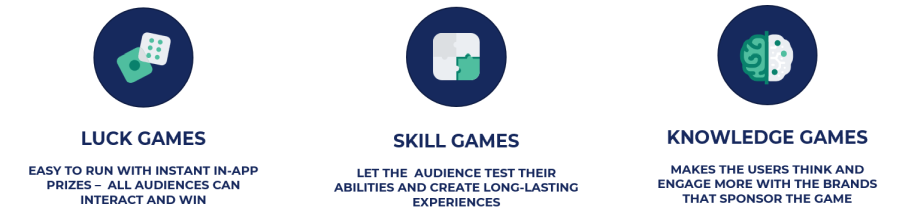
It is important to evaluate which game type fits best depending on the promotional campaign's objectives. You should take advantage of the various available games to maintain a diversified experience for your users.
Luck games
This game category represents formats that are recognized from the physical world like Spin the Wheel, Roll the Dice, or Scratchcard. These are easy to understand, require minimum effort, and are recommended for allocation of App Coupons at scale.
- Rock Paper Scissors - fun and efficient way to activate your audience with an engaging concept.
- Roll the Dice - simulates a well-known game of luck, in which a die is shaken around in a cup before being rolled out onto a table.
- Roulette - users test their luck as they try to guess the exact number the ball will land on.
- Scratchcard - users scratch fields hoping to reveal one or more winning images. This is often used in combination with the Advent Calendar.
- Slot Machine - users test their luck to try to get three of the same pictures in a row.
- Spin the Bottle - a fun variation on the traditional Wheel Of Fortune, a popular game of luck. In this version, it is not the wheel that spins but the marker in the middle.
- Tap To Reveal - users tap a chest or element to uncover a surprise behind it.
- Wheel of Fortune - users spin the wheel and test their luck to land on a prize.
Knowledge games
This game category allows your audience to show their knowledge in concepts like a Quiz or Guess the Image. When done right, this game concept creates a high level of engagement from the users.
- Calendar - allows players to open a new door each day or each week. Behind each door, there is a quiz question, and if the participant answers correctly, they can get a reward.
- Guess the Image - allows you to present users with visual content such as new product series, increasing brand awareness, or conveying a particular message.
- Quiz - using fun and challenging questions, you can test your customers’ knowledge about specific subjects, including your products or your company.
Skill games
This game category typically creates long-lasting experiences for your target audience with concepts like a Memory game, Drop Game, or Slice It. This game concept can challenge your audience as games can be set up to require some effort and focus.
- Bounce Battle - users control a paddle to keep the ball in play for as long as possible – each bounce earns points and increases the speed, testing precision and reaction time.
- Drop Game - like an updated version of a classic arcade game. Items falling from the top of the screen are either caught or avoided by a container.
- Match Matrix - fast puzzle game where players swap tiles to create matches of three or more. Each match clears tiles and scores points, while chain reactions and combos increase the total score.
- Memory Game - users have to memorize what is on the back side of each card they flip in order to match them in pairs. You can limit the number of moves they have, which makes it a challenge to complete the game.
- Shoot It - similar to the classic arcade game, users move the 'shooter' across the bottom of the screen to shoot falling images and collect points.
- Slice It - make your promotion engaging with an exciting game of skill! Users need to slice objects as they are thrown up on the screen while avoiding obstacles.